Strip now tattoo conscious
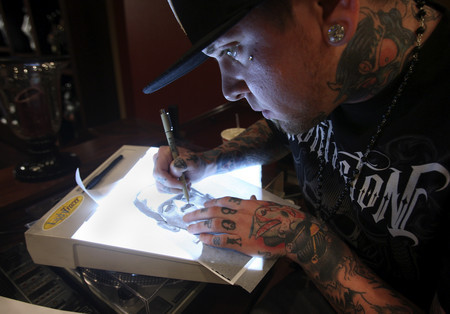
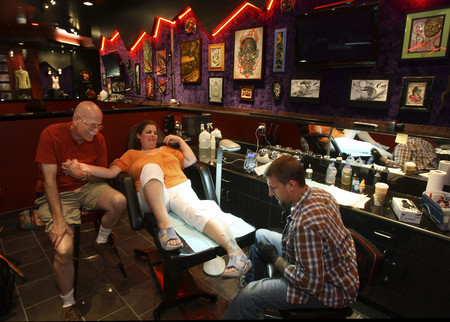
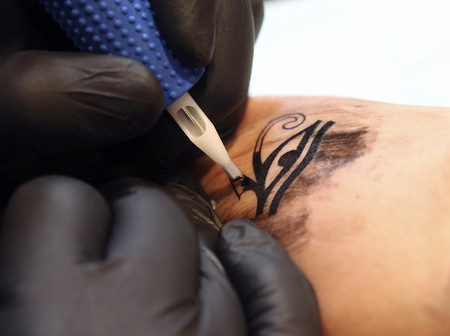




The marriage of tattoos and Strip casinos is something tattoo artist Mario Barth would never have imagined a few years ago.
"When I saw my logo for the first time on the marquee, I was like, are you kidding me?" said the Austrian-born Barth, who opened his shop, Starlight Tattoo at Mandalay Bay, in February 2008 after two years of talks with the gaming property.
"It is not looked upon as thug-related to be tattooed any more," John Huntington, owner of Huntington Ink at the Palms, said. "The tattoo styles have changed, the sterility has changed. People modifying their body has gone from plastic surgery and transferred over to the tattoo."
The tattoo industry has gone mainstream and is becoming big business, with nearly 24 percent of all adults in the United States having at least one tattoo, according to a 2006 article published in the Journal of the American Academy of Dermatology.
This social shift has not gone unnoticed by the casino industry either. Eight tattoo shops now operate inside Strip casinos with a ninth shop scheduled to open later this year.
The two industries' growing ties will be further displayed this weekend when 25,000 people are expected to attend The Biggest Tattoo Show On Earth, Barth's own convention, which will run the Mandalay Bay Convention Center today through Sunday.
In addition to having more than 1,000 tattoo artists in attendance, the convention will hold seminars on topics as varied as what tattoo shop owners need to know about individual and business taxes, legal aspects of the business and "How to succeed and accelerate your tattoo business," which will be presented by Barth himself.
The growing ties between tattoo shops and hotel-casinos is especially welcome now with the local tourism industry suffering because of the recession.
The tattoo convention has pushed Mandalay Bay's room rates this weekend to approximately $270 per night for a standard room to $780 per night for a two-bedroom suite.
When Barth first began pitching his business plan for a high-end tattoo lounge to Strip properties in 2005, the industry still carried a stigma.
But former Mandalay Bay President and Chief Operating Officer Bill Hornbuckle said the decision to let Barth open his Starlight Tattoo parlor in the hotel was relatively easy to make once he heard the plan.
"(Barth) presented a very viable business proposition," Hornbuckle said. "He wanted only to go first class to avoid so much of the stereotyping associated with tattoo parlors. His reputation was well-established as top in class."
That "top in class" commitment was what hooked Palms owner George Maloof, too.
He said that when he was approached about opening a tattoo shop at the Palms six years ago, he insisted on one provision.
"I just thought it would be great as long as it had a high-end look and was clean and it wasn't a typical tattoo salon that you find on the corner in a strip mall," Maloof said. "I wanted upper-class, sleek and that it have a good look."
Starlight Tattoo certainly doesn't look like your stereotypical dark and dingy tattoo parlor. The shop is brightly lit with large windows so people can watch the artists work, something that Barth believes helps put prospective customers at ease.
Starlight Tattoo was an instant success, Barth said, and the shop reached its first-year revenue projections after just four months.
Nearly 60 percent of Starlight Tattoo's revenues come from tattooing. The rest of the revenue comes from the sale of shirts, other clothing, jewelry and other items and from body piercings.
Huntington said the average tattoo in his shop is approximately $250, although several variables can drive a tattoo's price higher: "from the ink to colors, to how detailed and big the artwork is, to how long it takes do the tattoo."
Huntington credits casino executives' growing acceptance of tattoo parlors to the success of "Inked," a reality show that ran on the A&E network from 2004 to 2007.
The show, which covered activities at Hart & Huntington's shops including the one that opened at the Palms in 2004, helped destigmatize the industry for middle America, Huntington said.
"I think they saw how well they were doing and the amount of money they were generating and ... that they were driving a whole different demographic they wanted to their property," Huntington said.
Huntington believes the success of the Palms' Huntington Ink Tattoo Lounge was key to the growing kinship between slots and tats.
The successful efforts led other large casino companies to jump into the tattoo business, too.
Casino giant Harrah's Entertainment partnered with Motley Crüe lead singer Vince Neil to open two tattoo shops, at O'Shea's and the Rio, in the past four years.
Tattoo parlors also operate at the Miracle Mile Shop at Planet Hollywood Resort, the Hard Rock Hotel, the Riviera and the Sahara.
"I'm shocked it has turned out like that," Huntington said about the opening of tattoo shops inside hotel-casinos. "The places I really never expected (to see having tattoo parlors) were places like Mandalay Bay and those places. Now they're in the game, and I think it's great."
The relationship between hotel-casinos and tattoo shops shows few signs of abating anytime soon.
MGM Mirage, which owns Mandalay Bay, is partnering with Barth to open a second tattoo parlor on New Year's Eve at an undisclosed location.
And, although younger people have been the key demographic for tattoos -- the Academy of Dermatology's survey found 36 percent of Americans between 18 and 29 have at least one tattoo -- that might be changing.
Huntington said his first client at the Palms tattoo parlor was a 67-year-old woman who has used her casino players card points to get five more tattoos since 2004.
Further, he said, "I had a 69-year-old woman the other day who was getting her first tattoo.
"She was getting a little rose on her ankle," Huntington said. "I talked to her, and she said it was just something she wanted to do."
Contact reporter Arnold M. Knightly at aknightly@reviewjournal.com or 702-477-3893.
Slideshow